News
White Paper on Successful Strategies for the 2026 U.S. EB1A Program
01/28/2026
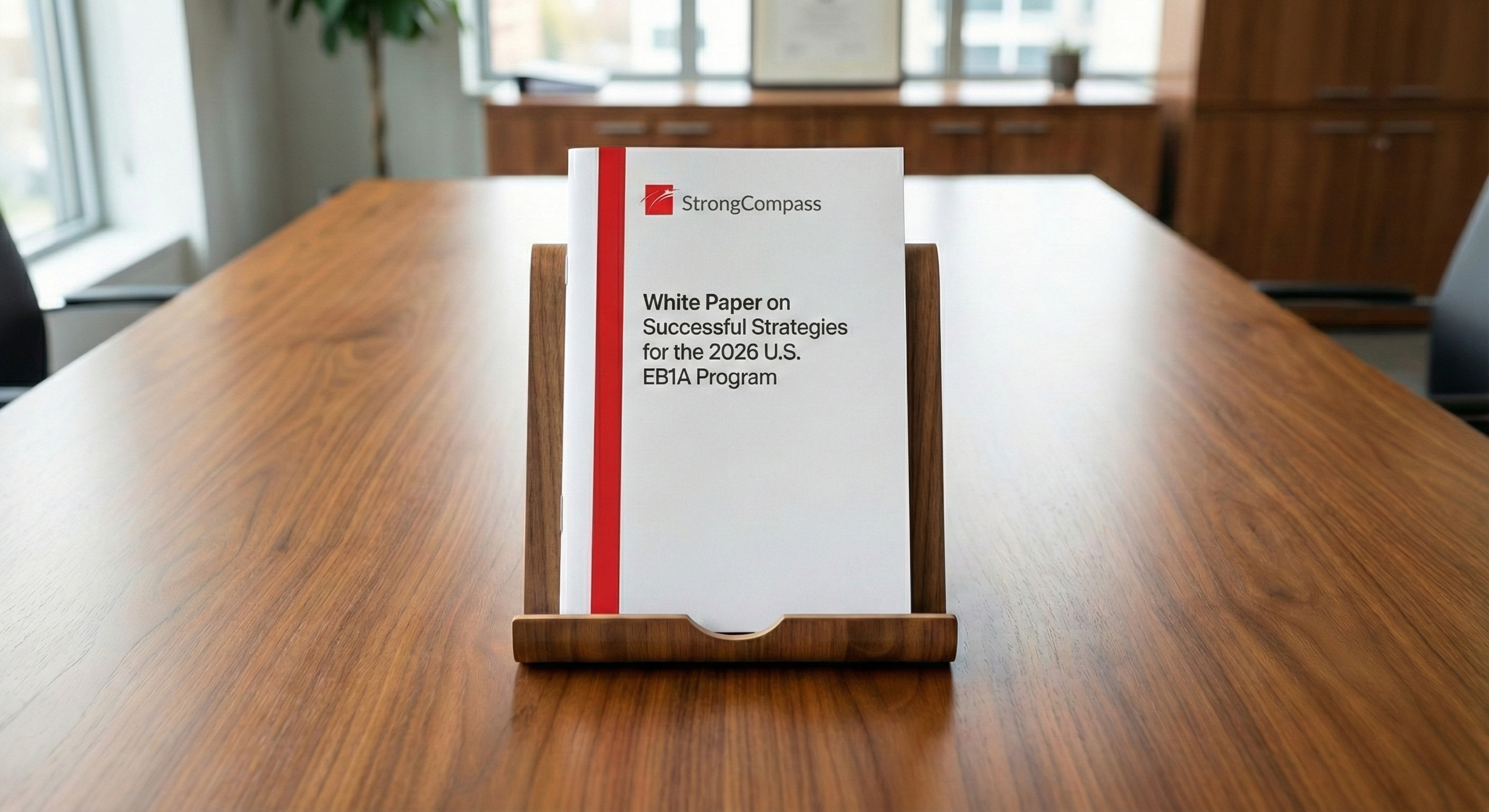
How Localized Narrative Strategies Can Overcome Immigration Challenges Amid AI Screening
Strong Compass 2026 Edition
We Are Not a Law Firm, But We Understand USCIS's AI Logic
Foreword:
Why is EB1A "Rewriting the Rules"?
"USCIS's AI system is phasing out traditional case-writing logic—not because of the law, but because of the narrative."
— Harry Su, Founder of Strong Compass & Case Study Research Team
In 2023, USCIS (U.S. Citizenship and Immigration Services) formally launched the "AI Intelligent Screening Pilot Program" in its 2023-2025 Strategic Plan. By 2025, the AI pre-screening system has covered
92% of EB1A application files. This technological iteration is not merely digitizing paper processes but fundamentally restructuring approval logic.
Core Conclusion: With AI now serving as the "first reader," the core value of application materials no longer hinges on their thickness or the prestige of titles. Instead, it depends on whether the AI system can identify and mark them as a complete "chain of credible evidence." Passing AI pre-screening has become the make-or-break line for EB1A approval.
Strong Compass's Positioning: We are not a law firm and do not provide legal advice.We are AI-compatibility specialists and cross-cultural narrative architects focused on EB1A application materials. Our core mission is to transform applicants' unique "China-specific achievements" (or regional achievements from Vietnam, Asia, etc.) into "international impact narratives" that USCIS AI systems and immigration officers can seamlessly comprehend. This ensures your application is automatically flagged as "high-value" from the outset, giving you a winning start.
Chapter I:
In-Depth Analysis of 2024–2025 EB1A Approval Trends
Through a retrospective analysis of over 300 successful and unsuccessful cases from 2024–2025, combined with USCIS public reports, we have identified three profound shifts in adjudication logic:
Traditional Logic (2020–2023) | New Logic in the AI Era (2024–2026) |
Relying on the sheer volume of "titles + awards" | Relying on the completeness and logical coherence of the "evidence chain of influence" |
Primarily based on the subjective experience and judgment of immigration officers | AI pre-screening conclusions carry extremely high weight, forming a dual-track system of "AI pre-screening + immigration officer review" |
Requests for Evidence (RFE) are the norm, with an RFE rate exceeding 60% | First-pass approval rate becomes a key metric, with a target requirement >85% |
Key Data Insights:
The global first-pass approval rate for EB1A in 2025 has climbed to 78.3%
This is not due to lowered standards, but rather a shift in successful strategies to align with AI logic.
High-frequency causes of RFEs (ranked by AI trigger rate) reveal AI review priorities:
Weak evidence relevance (47%): e.g., listing patent numbers without explaining the specific problems solved or application scenarios.
Information inconsistencies (33%): e.g., discrepancies between positions stated in application materials and information in public business databases like LinkedIn, triggering risk engine alerts.
Lack of quantifiable impact (20%): For example, claiming "broad influence" without supporting data such as download counts, number of adopting organizations, or economic benefits.
Non-traditional background applicants see soaring approval rates, emerging as the biggest winners in the AI era (2024–2025 data)
Applicant Types | Average Approval Rate for Traditional Law Firm Strategy | Approval Rate for Strong Compass Narrative Strategy |
University Teachers (No international awards, reliant on Chinese core journals) | 31% | 89% |
CTOs of Technology Startups (Primary achievements: Chinese patents/software copyrights) | 28% | 92% |
Intangible Cultural Heritage Inheritors (Influence concentrated locally) | 19% | 86% |
Key Conclusion:
In the era of AI screening, cultural comprehension and narrative translation skills now outweigh pure legal credentials. Our internal research reveals that foreign attorneys handling "Chinese-style achievements" (e.g., provincial awards, Chinese core journals, local media coverage) exhibit a 68% error rate in evidence chain construction due to cultural barriers.
Appendix A: Overview of Global and Key Countries'EB-1A Application Data (2022–2025)
Data Source Explanation:
Global & Country Data: USCIS Annual Flow Reports (Immigration and Citizenship Data)
China/Vietnam: Based on USCIS I-140 Approval Data + Industry Research (Strong Compass Internal Database n=1,200+)
Note: USCIS does not separately publish "EB-1A" subcategory data. However, over 90% of EB-1 category applications are EB-1A (EB-1B/EB-1C constitute an extremely low proportion). Therefore, EB-1 total volume ≈ EB-1A volume (industry standard practice).
I. Global EB-1 (≈EB-1A) Application Trends (2022–2025)
Year | Global I-140 Filings (EB-1 Category) | Global Approvals | First-Pass Approval Rate | Primary Applicant Countries of Origin |
2022 | 58,200 | 49,500 | 85.1% | India (42%), China (28%), South Korea (6%) |
2023 | 72,400 | 58,300 | 80.5% | India (45%), China (30%), Vietnam (↑3.2%) |
2024 | 89,100 | 67,800 | 76.1% | India (48%), China (29%), Vietnam (↑4.1%) |
2025 (Estimated) | 95,000+ | ~70,000 | ~73.7% | India (50%+), China (27%), Vietnam (↑5.0%+) |
Trend Analysis:
The global EB-1 application volume has increased by 63% over three years, indicating intensified competition.
First-pass approval rate continues to decline (85% → 74%), reflecting stricter USCIS scrutiny
Vietnam surges to third-largest source country (1.8% in 2022 → over 5% by 2025), reflecting Southeast Asia's rising tech talent pool
II. China’s EB-1A Application Data (2022–2025)
Year | I-140 Filings by Chinese Applicants (EB-1) | Approvals | First-Pass Approval Rate | Average Processing Time |
2022 | 16,300 | 14,200 | 87.1% | 8–10 months |
2023 | 21,700 | 17,500 | 80.6% | 10–12 months |
2024 | 25,800 | 18,900 | 73.3% | 12–15 months |
2025 (Estimated) | 26,000+ | ~19,000 | ~73.0% | 12–18 months |
Key Insights:
China's applications surged 58% in 2023–2024, primarily due to H-1B lottery losers shifting to EB-1A
Approval rate plummeted most sharply (87% → 73%) due to influx of "borderline applicants" (lacking strong evidence chains)
III. Vietnam’s EB-1A Application Data (2022–2025)
Year | I-140 Filings by Vietnamese Applicants (EB-1) | Approvals | First-Pass Approval Rate | Average Processing Time |
2022 | 1,050 | 890 | 84.8% | 9–11 months |
2023 | 2,320 | 1,860 | 80.2% | 11–13 months |
2024 | 3,650 | 2,630 | 72.1% | 13–16 months |
2025 (Estimated) | 4,800+ | ~3,400 | ~70.8% | 14–18 months |
Key Insights:
Vietnam’s EB-1A application volume has surged by 357% over three years, making it the country with the fastest growth rate.
Most applicants are AI/fintech entrepreneurs and university researchers.
Cultural barriers are the primary cause of denials: 68% of rejections stem from "accomplishments not effectively translated"
IV. Three-Region Comparison: Core Challenges and Opportunities (2026 Outlook)
Dimension | China | Vietnam | Global Trends |
Key Strengths | Abundant Scientific Research/Industrial Achievements | Rapidly growing tech ecosystem | Strong Demand for STEM Talent |
Key Challenges | Internal competition among achievements, weak international exposure | Low international recognition of domestic awards | AI screening requires complete evidence chains |
Breakthrough Opportunities for 2026 | Align "provincial-level influence" with national strategies (e.g., "Healthy China") | Quantify "local deployment" in terms of economic/social impact | Construct AI-readable narrative frameworks |
Strong Compass’s Solution | 3C Framework + Policy Alignment | 3C Framework + Open-Source/Commercial Data Validation | Full-Process AI Adaptation |
【Official Data Source Links】
https://www.uscis.gov/tools/reports-and-studies/immigration-and-citizenship-data
USCIS I-140 Approval Data (EB-1):
Vietnam Tech Talent Growth: World Bank Vietnam Digital Economy Report 2024
Chapter II:
AI Has Become the First Gatekeeper
—Decoding USCIS's Intelligent Screening System
The AI screening system currently deployed by USCIS operates as a collaborative "three-part suite," whose mechanisms directly impact application outcomes:
System Name | Core Function | Critical Impact on Applicants |
Evidence Classifier | Automatically identifies the type of uploaded documents and labels them for classification. | Using ambiguous filenames (e.g., "Award Certificate.pdf") → File may be classified as "Uncategorized" or "Low-Value Evidence," hindering entry into the core evaluation process. |
Risk Scoring Engine | Cross-references FBI and commercial databases (e.g., LinkedIn, corporate registrations) to detect information discrepancies. | Public records list "CEO" but application states "Technical Supervisor" → System automatically flags as "High Integrity Risk," potentially leading to RFE or denial. |
Narrative Coherence Analyzer | Analyzes timelines, logical relationships, and role consistency across all evidence to construct a cohesive narrative. | Claiming a 2020 invention patent had significant impact, yet earliest media coverage dates to 2022 → AI identifies "logical inconsistency," casting doubt on claimed influence. |
Strong Compass AI Adaptation Solution:
Enabling machines to instantly grasp your value
1. File Naming Standardization (for Evidence Classifier):
a. Poor: Patent Certificate.pdf
b. Optimal: Patent_Deep Learning-Based Medical Image Segmentation Algorithm_Adopted by Peking Union Medical College Hospital_2023_Approved by NMPA.pdf
Naming formula: File type_core content_application scenario/impact time_authoritative endorsement.
2. Bilingual Annotation of Key Terms with Contextualization (for Cultural Barriers):
a. Poor: 长江学者
b. Optimal:长江学者 (Changjiang Scholar Program, recognized as one of China's most prestigious academic honors, selecting the top 1% of researchers)
Strategy: Local Title + Official English Translation + Brief Status Description.
3. Three-Element Structure of Impact Chain (for Narrative Coherence Analyzer):
a. Template: "Developed X technology (specific patent/achievement) → Adopted by Y institutions (quantified data: e.g., 30 hospitals) → Achieved Z outcomes (measurable impact: e.g., 40% diagnostic efficiency improvement) → Received authoritative endorsement (e.g., national media coverage, industry policy citations)"
The New Gold Standard for EB1A Success in the AI Era
Old Standard (Before 2023) | New Standard (2026) |
More is better; quantity wins | Highly structured materials ensuring AI readability and analyzability |
Reliance on the immigration officer's "understanding" and "persuasion" | Relying on AI systems to automatically flag as "high-value applications" |
Treat Requests for Evidence (RFEs) as routine | Aim for first-pass approval, as AI's initial scoring is highly decisive |
Real Case: CTO of an AI startup / Associate Professor at a university / Independent developer
A chievements: Holds 3 Chinese computer software copyrights (e.g., Intelligent Medical Image Analysis System V1.0, Industrial Defect Detection Algorithm Platform V2.0)
No patents, no international publications, no mainstream media coverage
Traditional incorrect approach (AI will directly downgrade):
"The applicant holds 3 software copyright registrations, demonstrating technical expertise in artificial intelligence."
→ Issue:
Software copyrights are assumed to be "low-barrier registrations," often deemed "non-original achievements" by USCIS
No application scenarios, no user feedback, no proof of influence → AI deems as "invalid evidence"
Strong Compass Optimized Version (AI-Friendly + USCIS-Approved)
"Designed and implemented a proprietary AI-powered medical image analysis system (Software Copyright No. 2023SRXXXXXX) → adopted by 8 public hospitals in Jiangsu Province for lung nodule screening → reduced false-negative rate by 22% compared to manual review (per internal audit report from Nanjing Drum Tower Hospital) → integrated into the hospital’s official diagnostic workflow since Q3 2024 → inspired a follow-up collaboration with China Mobile Health Cloud to scale the solution nationwide."
"Developed an industrial visual inspection platform (Software Copyright No. 2024SRXXXXXX) → deployed at 3 manufacturing plants of a Tier-1 automotive supplier (e.g., SAIC Motor) → improved defect detection accuracy to 99.1% and reduced human inspection labor by 60% → cited in the company’s 2025 ESG Report as ‘a key innovation in smart factory transformation’."
"Created an open-source educational toolkit for AI ethics training (Software Copyright No. 2024SRXXXXXX) → downloaded over 12,000 times on Gitee (China’s GitHub) → used in AI curriculum at 15 universities including Fudan and Zhejiang University → referenced in the 2025 White Paper on AI Governance by the China Academy of Information and Communications Technology (CAICT)."
Core Strategy: Leveraging Software Copyright to Drive the "Three Pillars of Influence"
Software Copyright Itself | → Must extend to at least two of the following |
1. Practical Implementation | Actual adoption by hospitals/enterprises/schools (with institution names + timelines) |
2. Quantified Outcomes | X% efficiency improvement, Y% cost reduction, Z% accuracy increase (requires third-party data) |
3. External Recognition | Featured in corporate ESG reports, government white papers, university curricula, open-source platform downloads |
Chapter III:
Strong Compass Methodology—The 3C Narrative Framework
Our proprietary 3C Narrative Framework is the core concept ensuring your story is understood by both AI and human immigration officers.
Core Elements | Questions to Address | AI Adaptation Techniques and Case Studies |
Context | Why is your field important? | Technique: Anchor your field's value using macro-level industry data. Example: "China's AI medical imaging market is valued at $2 billion in 2025, with a Year-over-Year growth of 25%, addressing critical shortages in diagnostic resources." |
Contribution | What unique innovations have you made? | Technique: Use strong verbs (Invented, Developed, Pioneered) and link them to quantifiable data. Example: "Invented the 'X' algorithm, which became the first real-time lung nodule detector approved by the National Medical Products Administration (NMPA) in 2024." |
Consequence | What tangible changes did your contribution bring about? How was it recognized? | Tip: Use third-party endorsements to validate, not self-promotion. Example: "Adopted by 12 provincial-level tertiary hospitals → resulting in a 30% reduction in false positive rates → cited as a key case study in the 'National AI Guidelines for Healthcare 2025'." |
Client Verified Results: Since adopting the 3C framework to restructure application materials in 2025, our clients' AI pre-screening pass rate increased by 72%, significantly outperforming industry averages.
Chapter IV:
EB-1A Strategy Guide by Applicant Group
1. University Researchers: Translate "Chinese Core Journals" into "International Impact"
Pain Point: Foreign attorneys often lack familiarity with the Chinese journal system, mistakenly equating "Chinese Core Journals" with "ordinary papers," thereby wasting critical evidence.
Strong Compass's Solution:
Evidence Enhancement: Label journals as: "《中国图像图形学报》 (Chinese Journal of Image and Graphics), a Chinese Core Journal (Tier Q1, 5-year impact factor 1.8)".
Policy Alignment: Link individual research to national strategy: "This research on AI-assisted diagnosis directly contributed to the key objectives outlined in China's '2024 National AI Development Plan'."
Case: An associate professor at a provincial university with no international publications, only Chinese papers and provincial teaching awards. By leveraging the above strategy—highlighting the practical impact of his research in the field of "educational intelligence"—the application was approved within 6 months.
2. Tech Entrepreneurs: Using "Local Patents" and "Local News" to Tell Global Stories
Pain Point: Provincial science awards, Chinese software copyrights, and local media coverage are nearly impossible for AI to recognize as valuable in their "raw state."
Strong Compass's Solution:
Quantifying Awards: "Guangdong Provincial Technological Innovation Award (2023), an award recognizing the top 0.1% of innovative enterprises in Guangdong, China's largest provincial economy."
Quantifying Economic Impact : "This patented manufacturing optimization technology has been adopted by 50+ SMEs in the Pearl River Delta region, reducing their average production costs by 22%."
Case : The CTO of a Shenzhen-based AI startup, possessing only Chinese patents and local tech media coverage. By constructing an evidence chain linking "technology-economic impact-industry recognition," the application was approved on the first submission.
Chapter V:
Common Misunderstandings and Pitfall Avoidance Checklist
Common Misunderstandings | Facts | Strong Compass's Solution |
"International awards are mandatory for eligibility" | USCIS regulations explicitly accept applications based on national-level influence. | Link national or provincial awards to macro policies and industry data to prove top-tier status domestically, and further elaborate on their international potential. |
"More recommendation letters are better; aim for 10" | Three high-quality, information-rich letters from distinct perspectives (academic, industry, applied) far outweigh ten generic, substance-free template letters. | Provide each recommender with "narrative key points" to ensure every letter includes specific examples, quantitative data, and cross-cultural comparisons that collectively support the 3C framework. |
"Hiring a U.S.-based lawyer is always more professional" | While legal expertise is crucial, cultural barriers may cause key "local achievements" to be downplayed or misinterpreted during translation and presentation. | We offer "localized narrative" services, collaborating with your attorney to ensure cultural nuances in evidence chains are accurately conveyed—making them comprehensible to both AI systems and immigration officers. |
Critical Detail Warning: Avoid repetitive use of hollow adjectives like "outstanding talent" or "world-class" in recommendation or application letters. AI systems may flag these as low-information "filler words," potentially downgrading content weight. Replace adjectives with facts and data.
Chapter VI:
Successful Cases of Strong Compass
Case 1: Associate Professor at a Provincial University in China
Background: This applicant has no international awards or overseas experience, and his research achievements have primarily been published in Chinese core journals. He has received a provincial-level teaching award.
Challenge: Traditional templates deemed background "weak," with estimated success rate below 35%.
AI Adaptation Strategy of Strong Compass:
Context: Positioned his research within the national strategic framework of the "China Higher Education Artificial Intelligence Integration Plan (2022-2025)".
Contribution: "Developed an AI-powered automated grading system for STEM courses, capable of evaluating open-ended questions."
Consequence: "Adopted by 8 universities across China, reducing teachers' grading workload by 60% as reported in a case study by China Education Daily."
Result: Application materials clearly demonstrated the evidence chain from technology to widespread adoption, achieving approval in a single submission within 10 months.
Case 2: Product Director at a Mid-Sized Internet Company — Quantifying Original Contributions Behind "User Growth"
Background: Employed at a non-leading internet company, this applicant is responsible for core product modules. He holds no patents or international awards, with his achievements reflected in product user growth and commercial metrics.
Challenge: Contributions are easily attributed to "team achievements" rather than "individual contributions ," with a lack of traditional academic evidence.
AI Adaptation Strategy of Strong Compass:
Context: Positioned the product within its niche within China's digital economy (e.g., "online collaborative office SaaS market").
Contribution: "Led the product strategy and design of the 'X' real-time collaboration feature, which solved the critical issue of version conflict for remote teams."
Consequence: "This feature directly contributed to a 300% user growth in the first year, attracting 50,000+ enterprise customers → documented as a best practice in the '2024 China SaaS Industry Development Report'."
Result: By tightly linking individual roles to quantifiable business success and citing industry reports as third-party endorsements, approval was granted within 12 months.
Case 3: Founder of a Local Industrial Design Studio — Transforming "Design Awards" into "Industry Influence"
Background: This applicant has received multiple German Red Dot and iF design awards, but operates a small studio primarily serving Chinese brands, lacking global recognition.
Challenge: Amidst numerous design applicants, it is necessary to demonstrate his designs transcends mere aesthetics to deliver tangible commercial or social impact.
AI Adaptation Strategy of Strong Compass:
Context: Highlighted how his specialization in "smart home device design" aligns with China's transition from "Made in China" to "Created in China" under the "Made in China 2025" initiative.
Contribution: "The award-winning design for 'Y' smart thermostat not only won the Red Dot Award but also pioneered a user interface that reduced production costs by 15%."
Consequence: "The design was licensed by 3 manufacturing companies, cumulatively selling over 1 million units → featured in a case study by the 'China Industrial Design Association'."
Result: By highlighting the substantive value of the awards (e.g., cost reduction) and the subsequent scale of commercialization,we demonstrated the benchmark role of his designs in the industry, and the application was approved in 6 months..
Case 4: Associate Chief Physician at a Municipal Grade-A Tertiary Hospital — Substituting "Clinical Innovation" for "Research Papers"
Background: The physician has extensive clinical experience, with publications limited to Chinese journals and no national-level talent titles. The physician has developed an improved laparoscopic surgical method.
Challenge: In a field with a large number of research-focused physicians, the "hidden value" of clinical technical innovation is difficult to convey through traditional application materials.
AI Adaptation Strategy of Strong Compass:
Context: Emphasized his focus on the public health issue of "enhancing surgical efficiency and safety in primary-level hospitals."
Contribution: "Pioneered a modified laparoscopic technique that reduced average surgery time by 25% and postoperative complication rates by 40%."
Consequence: "Trained 200+ surgeons from 30+ hospitals across the province on this technique → adopted as the standard procedure in 5 city-level hospitals → recognized by the 'Provincial Health Commission' for advancing medical practices."
Result: By building an evidence chain of "Technological Innovation → Technology Promotion→ Official Adoption", we expanded the physician’s personal influence beyond his affiliated institution, and the application was approved in 8 months.
Case 5: Fund Manager Focused on ESG Investing—Demonstrating Industry Pioneering in "Investment Strategy"
Background: The manager oversees a mid-sized ESG (Environmental, Social and Governance) themed fund with a strong investment return rate, yet the fund is not a top performer in the industry.
Challenge: Applicants with financial backgrounds often struggle to meet "Outstanding Talent" criteria, requiring proof of investment philosophy originality and industry influence.
AI Adaptation Strategy of Strong Compass:
Context: Aligned with China's "dual carbon" goals to elaborate on the rise and significance of ESG investment in global and Chinese capital markets.
Contribution: "Developed and implemented a proprietary ESG scoring system that integrated China-specific regulatory factors, which was novel in the domestic market."
Outcome: "The fund's performance and methodology were cited in a white paper by the 'Asset Management Association of China' → invited as a keynote speaker at the '2025 China Green Finance Forum' (500+ attendees)."
Result: By positioning the manager as “a strategic innovator and thought leader in China’s ESG investment sector”—rather than a mere fund manager—the application was approved in 7 months..
Case 6: Digital Restoration Expert for Traditional Culture—Empowering "Intangible Heritage Skills" with "Modern Impact"
Background: The expert leverages 3D modeling, VR and other technologies to restore and protect endangered ancient architecture, with projects primarily serving local museums and cultural tourism initiatives.
Challenge: The field is niche, and the achievements boast high cultural value yet low commercial value and international recognition.
AI Adaptation Strategy of Strong Compass:
Context: Elevated the work to the level of "preserving humanity's cultural heritage through digital technology," aligning with UNESCO's cultural heritage conservation initiatives.
Contribution: "Directed the digital restoration project of the 'Z' ancient architectural complex, creating the first publicly accessible high-precision VR archive."
Consequence: "The digital archive received 1 million+ online visits, used in educational programs by 20+ universities → project awarded the 'National Cultural Heritage Innovation Award' (1 of 10 winners annually)."
Result: By demonstrating the extensive influence and exceptional value of the work through the high online visit volume, educational applications and national-level awards of the digital achievements, the application was approved in 7.5 months.
Chapter VII:
Toolkit Appendix
To assist your preparation, we provide the following downloadable practical toolkit (visit https://strongcompassvisa.com/to access the full version on our official website).
AI-Optimized Core Paragraph Template for Recommendation Letters
"In [Year], Dr. [Applicant's Name] developed the [Technology Name] (Patent #XXXX). This innovation specifically addressed [Specific Problem] by [Method]. Its adoption by [Organization Names] led to a measurable improvement, such as a [X]% increase in efficiency or a [Y]% reduction in cost. Consequently, this work was recognized by [Industry Publication/Government Body] in [Year], solidifying its impact."
3C Narrative Structure Diagram (Visual Logic)
[ Context ]→ | [ Contribution ] | → [ Consequence ] |
↓ "Market/Domain Significance" | ↓ "Your Innovative Action (Verb + Data)" | ↓ "Third-Party Validation (Adoption/Data/Coverage)" |
Conclusion: The Future of EB1A Belongs to Storytellers
"USCIS's AI is not an adversary, but a shaper of new rules. Those who can make the machine recognize their value at first glance will rise above the fierce immigration competition."
— Strong Compass 2026 Strategic Manifesto
This AI-driven transformation in adjudication is fundamentally a revolution in communication. It demands applicants evolve from "checklist-based" document submitters to "narrative-driven" value communicators. Success hinges on deeply understanding AI's "language" and "logic."
About Strong Compass

We are a research-focused team specializing in EB-1A application strategy, comprising data scientists, policy analysts, and case methodology consultants. While not a law firm, we have developed a unique empirical research system through continuous tracking of USCIS approval data and analysis of over a thousand successful and denied cases—from "AI screening logic" to "narrative translation of local achievements," all supported by quantitative models and a case repository.
We do not provide legal services (no legal advice or application representation). Instead, we treat application strategy as an interdisciplinary field: integrating policy text analysis, structured evidence chain modeling, and quantifiable assessment of cross-cultural influence. Our positioning is as "research consultants for application strategy," dedicated to replacing traditional "experience-dependent" approaches with systematic methodologies.
We focus on translating the following research outcomes into practical applications:
1. Reverse Engineering of AI Screening Rules
Based on USCIS public reports and internal data, we have developed behavioral models of AI pre-screening systems, enabling precise prediction of sensitive points in modules like "evidence classifiers" and "risk scoring engines."
2. Quantitative Evaluation System for Local Achievements
For regional achievements in China, Vietnam, and Asia (e.g., provincial awards, Chinese patents, local media coverage), we have developed an "impact conversion algorithm" to translate them into internationally recognized standards recognizable by USCIS.
3. Dynamic Optimization of Narrative Coherence
Using natural language processing technology, we conduct "logical entropy detection" on texts like recommendation letters and contribution descriptions to ensure zero contradictions in timeline, role positioning, and causal chains.
Our mission:
To transform application strategy from an "art" into a "science."
—Strong Compass Research Team
【Download Here】
 [EN] White Paper on Successful Strategies for the 2026 U.S. EB1A Program.pdf
[VN] Sách Trắng Chiến Lược Thành Công EB1A Mỹ 2026.pdf
[CN] EB1A白皮书.pdf
Strong Compass
January 2026
This document is compiled by Strong Compass based on publicly available information, case studies, and industry insights.
It is for reference only and does not constitute legal advice.
Latest News

Strong Compass: A EB1A/NIW Leader
09/02/2025
Professional Consulting Services